A Tone-Deaf TikTok and the Leftist Case for Voting Kamala

There’s been quite the firestorm on my TikTok For You Page this past week over a short video posted by leftist user moschinodorito. In the video, he references the police killing of Sonya Massey to mock liberal support of Kamala Harris. The response has been largely, and often viscerally, negative. I’ve watched several Black TikTok users stitch his video with responses mostly focusing on his insensitivity, using Massey’s killing (but not her name) to make a smarmy point about liberals and the upcoming presidential election. He’s been accused of being racist, using Black people as “pawns” in his own approach and outlook regarding politics. Some have cast him as a stand-in for cishet white male leftists in general, guilty of worshipping and reciting theory in place of organizing or other forms of direct action. His video has basically triggered a wave of grievances that I have to admit surprised me in a couple ways.

My initial reaction to his video was nonchalance, to be totally honest. While lazy, crude, and dark, I immediately understood the ironic and frustrating juxtaposition he was pointing out: while witnessing yet another innocent Black American slaughtered by an unhinged white police officer, we’re still awash with enthusiastic Democratic endorsements of a former prosecutor for the party’s presidential nomination after Joe Biden announced he is ending his reelection campaign. But the negative reactions, particularly those of Black users sharing their thoughts, forced me to sit with some discomfort, because my impulse upon initially seeing these responses was to defend him.

As a white male leftist myself, I probably have to admit to some internal bias here. I loathe the thought that I may contain these blind spots, these impulses and reactions that are functionally inconsiderate of the very marginalized populations my ideology is meant to protect and support. I thought, “How could he be out of line here? He’s outraged by racist police violence! He’s mocking the cruel and twisted system that perpetuates all this suffering!” But I quickly came to understand I was missing the point. His oversimplification of the situation, and for that matter, his attempt to try and draw a direct connection between Massey’s killing and Harris’ candidacy, was paternalistic and insensitive. It was a cheap attempt to feel superior and incisive.

As much as my feeling on his video has changed, there are still some frustrations I have about some of the criticism he’s receiving. But I don’t want to get any more bogged down in the discourse over this video itself. In at least one vital way, it’s not really my place to die on a hill defending a misguided attempt at satirizing racial violence against a minority group to which I do not belong, lest I run afoul of the same sort of mistake he made, regardless of my good intentions. What has really stuck with me about this was a somewhat tangential discourse about voting in general elections, and what that does or does not mean.

____________________________________________

Like most leftist-inclined people I encounter online, I have immense contempt for Democratic party leadership. Their complicity in many of the most pressing sociopolitical disasters – imperialism, economic austerity, the war on drugs, the carceral state, insufficient action on climate change, and support for the Israeli government’s depravity, to name a few – is beyond any serious question in my opinion. One natural outcome of this is the disgust this engenders in left-wing voters when liberals and Democratic officials insist that we keep checking the box next to whichever candidates are thrust forth with a “D” next to their name. To “Vote Blue No Matter Who.” We’re simultaneously condescended to for our alleged “purity politics” and ignored on nearly all matters of policy, particularly anything that would be a break with the way the government has operated after the instruments of The New Deal were steadily left to die or outright killed by Democrats and Republicans alike. I could go on regarding this matter of The Discourse, but it would quickly turn redundant and a bit whiny. Suffice it to say, there’s plenty of reason for any leftist to feel frustrated and exhausted by the Democratic establishment and the resulting liberal rhetoric.

All these valid and real frustrations aside, I believe there is still a strong case to be made that voting for Kamala Harris – or probably any Democratic candidate that could potentially arise following the DNC next month – in the 2024 presidential election is the most appropriate choice for a sincere leftist this November. The ultimate reason is one I assume any reader would be familiar with: defeating Donald Trump and a Republican presidential attempt to implement the actions proposed in The Heritage Foundation’s Project 2025. But I don’t want to focus entirely on that reason. Rather, with the amount of left-wing avowal to either abstain or vote third-party, I want to build the case for voting Kamala as a small but significant action of left-wing values itself.

____________________________________________

As someone who was resistant to voting for Joe Biden this November myself, I know what it’s like to hear this frustrating appeal to harm reduction. And while it is a relief to see Biden’s particularly abhorrent personal commitment to Zionism off the ticket, I fully understand that Kamala Harris and her yet-to-be-named running mate are unlikely to break in any meaningful way from supporting the Israeli government’s bloodthirst. And make no mistake, that is the issue at the moment driving most left-wing refusal to vote for a Democrat in this general election: Israel’s staggering escalation of the Palestinian genocide. Yes, the Democratic establishment has failed on many other urgent issues – insufficient mitigation of climate change, no meaningful police reform, the War on Drugs and mass incarceration, dismal healthcare policy, capitulation to Wall Street, to name a few – but the slaughter of Palestinians with the material and political support of our federal government has justifiably sickened anyone with a conscience. And from my own feelings and those I’ve heard expressed from many other people on social media, it’s that matter of conscience that leaves people disgusted with the notion of voting for Harris – particularly the feeling of support of or complicity in the genocide that we may attach to the act of voting for her.

But the discussion surrounding moschinodorito’s video has really led me to not just reconsider this framing of what it personally means to vote for a particular candidate, but also the role of voting in the greater context of political action at this moment in American history.

____________________________________________

First, the matter of personal conscience in selecting a candidate. In a culture that has instilled within us a strong focus on individualism and personal responsibility, but also a political system that has disenfranchised and disempowered us in countless ways, we’re left in a cruelly disorienting position. For those of us with a strong sense of indignation at systemic injustice and the accompanying alienation it has engendered, we naturally crave any little way we can think to push back and enact whatever power we can muster. And that, I believe, is an origin of this fervent sense we have to directly associate our vote with a deep, personal reflection of our values. We’re so disenfranchised and disconnected from power that we place outsized influence on the one small act that is left to us (mostly) without resistance from the institutions of power. Couple this with the often-nauseating liberal fetishization of voting and their bad-faith condescension toward any left-leaning people that dare refuse to unenthusiastically play along, and we have spite in the mix. Thus, the notion of voting third party or just skipping that section of the ballot altogether is a way we can attempt to feel good and righteous in contrast to the vocal supporters of a party we know has routinely failed us. It allows us to view this as a staunch refusal to participate in the various and sundry miseries our elected (and unelected) leaders inflict upon the world. And I believe we’re mistaken in this sort of thinking. If I’m truly honest with myself, I have to admit it’s fair to even consider it selfish. It’s an understandable, but effectively destructive impulse to elevate our personal feelings above the increased harm that I think any honest leftist knows would come with a second Trump term.

And so, I think we can just unclench and let go of all this pressure, for lack of a better word, and be realistic about this election. The only meaningful thing we can achieve with this election is the defeat of Donald Trump, but that does have enough meaning to warrant all this bluster. With neither candidate willing to oppose Israel and cut off the supply of weapons and political cover, the plight of Palestine is off the table for us at the voting booth this November. There is nothing we can do, no box that we can check that will do a fucking thing to change it electorally. It’s disgusting, infuriating, and devastating that we’re in this position. But it’s not our fault. We need not place that burden upon ourselves as general election voters. The protests, BDS, other pressure campaigns, and all other direct action available to us is where that fight has to take place at the moment. ____________________________________________

The second thing I wanted to touch on regarding this issue is the significance of voting itself in the larger process of sociopolitical change. I admittedly have less to say about this because I am not well-versed in the theory or practice of organizing and direct action, but it’s still worth mentioning because I often see this topic mentioned by leftists as a contrast to electoralism. And despite my lack of deep study on the matter, I’ve listened to and read enough discussion on the matter to acknowledge that electoralism, at least in its current form in the United States, is not a key driver for progress as we would define it. In fact, I think it would be absurd to deny it. And my point here is that electoralism’s very nature as a futile method of revolution is another reason leftists should consider dropping their strong opposition to participating in it on its own, limited terms.

So, why should we still allow ourselves to be so worked up about it? We need not fully remove ourselves from the equation just because of voting’s limitations. We need not overreact to liberals’ obnoxious and ignorant tendency to reduce the entire political process to voting every two years and treat everyone to their left like children. It can be such a misuse of energy to allow these frustrations to drive us away from the very narrow but crucial act of opposing Trump and the Republicans Party’s national project. Voting Harris is just a one-day side-quest that can mean so much to women, our LGBTQ+ neighbors, and the newly revived labor movement.

____________________________________________

Voting for Kamala Harris is not an implicit endorsement of her or the Democratic Party. It is not moral or spiritual support of Israel’s genocide, and it does not reflect on any of us. It is purely a small act of opposition to the specter of a second Trump administration. And to damn them with such faint and pitiful praise, it can be a wrench thrown into the gears of so many horrible machinations that the Democratic party is less eagerly committed to visiting upon us compared to the increasingly ravenous GOP. Because regardless of what we do in November, or who wins, we’re still left with the same responsibility to each other and our world every day moving forward. We’re still faced with the overwhelming cruelty that the corporate, imperial juggernaut that is Washington inflicts upon humanity every day. Grim as it feels, casting your vote for the Democratic candidate is a meaningful and direct opposition to Trump. And if that can, even in a small way, lessen the difficulty of our struggle against our oppressors, then I think it’s fully consistent with our leftist values to do so.

We Know You Know Better

Online Libs are addicted to pointing out the right’s hypocrisy. They love it to death. Sure, it’s often warranted and satisfying, but it’s ultimately pointless and played out. Plenty of progressives, leftists, and media critics have caught onto this game and have offered a range of insight into the impotent, masturbatory, but most importantly, misguided nature of it. It’s a worthy topic for thought, especially if you’re the type, for example, to think you’ve “destroyed” some evangelical bigot by telling him he isn’t Christ-like. Trust me, he knows. And he’ll have an asinine retort or scripture passage to respond with, and he doesn’t care anyway. That’s the point. He’s not playing the same game you are.

This post isn’t mean to dive into that idea. It’s already been tackled by people much more talented and thorough than I am. But the semi-recent and massive increase anti-trans hysteria, accompanied by a growing wave of restrictive and brutal bills in state houses throughout the country, has gotten me thinking about a tangential aspect of The Discourse: most of the Online Right aren’t just hypocritical in their views and eager to deploy an array of absurd lies to support them. Rather, they’re simply lying when they tell you what they think and believe. And to varying degrees, I think most know it themselves.

To get something out of the way, I like to think it’s obvious I’m not talking about the rare few who openly admit to their bigotries or “-isms” of choice, as heinous and jarring as they might be. Most people across the ideological spectrum like to think they’re the Good Guys, or at the very least, will attempt to convince others of this conviction. One would reasonably think it should be easy to default to some sort of fundamental values or ideological framework when defending a belief or statement from criticism. These are the reactionaries I am talking about, and this is where they run into trouble, when they cannot honestly counter any good-faith critique. To use transgender rights as an example, I would simply and honestly state that someone’s personal and intimate experience should respected without interference from the state when it comes to the care they need to live their preferred gender expression. But even though they believe the opposite, you are unlikely to see a right winger explicitly state it as such – that they do believe it is critical for government to intervene in such personal matters in order to maintain a direct sex and gender binary in its citizens. So, they have to frame it differently to hide that fundamental belief.

Regardless of whether they’re aware of the internal hypocrisy, they know it sounds bad. There’s no escaping the implication of these beliefs, as evidenced by the actual content of the bills being proposed and passed. Thus, the belief has to be masked by concern-trolling language, laundered through faux compassion for children or women. Perhaps even the old “just asking questions” gambit. This just kicks the can down the street a little: why assume kids cannot understand the basics of gender expression? Why the leap to the conclusion that LGBT+ education/exposure is grooming? Why paint all of cis womanhood as threatened by or opposed to transgender people? This is all just more ugliness, often being passed off as “concern” of some sort, and to engage with it is to become mired down in a debate that allows bigots to claim some level of legitimacy and prudence. Essentially, they could argue that the very existence of this heated discussion is reason enough to warrant respect for their views as something that isn’t just simple prejudice or outright hatred. But it’s not an honest discussion on the matter: it’s a fight started and fueled by people who deny others’ humanity. It’s not a reasonable discussion on a matter, such as education policy around gender expression, or more banal details around how transgender rights could be outlined. It truly does boil down to a fight over the right for certain, innocent people to simply exist as they wish. And the people who oppose them know this, despite whatever watered down rhetoric or outright obfuscation they deploy.

My focus on transphobia is the result of the current moment, but this brand of dishonest sadism-masquerading-as-concern is prevalent. A few years ago there was a frenzy over the pressure to remove public monuments of Confederate officials and military figures. The conservative pushback included fears of “erasing history,” as if these statues were crucial to education and knowledge to begin with. The lie had to be deployed to cover for the obviously icky alternative of having to admit appreciation for the Confederacy’s pro-slavery enemies, or at the very least functioned as a lazy attempt to avoid the essentially impossible task of defending the purpose and value of such public monuments. Thus, “you can’t erase history” is “the Confederacy wasn’t bad (enough).”

The anti-abortion (“pro-life”) movement is another fascinating example. While there is room for some more nuance here, particularly for the seemingly rare true-believers whose activism is displayed as near universal compassion extending well beyond the issue of abortion, much of the movement’s reasoning can be translated to its true, dishonest meaning and dismissed accordingly. Skipping past some obvious surface level hypocrisies – violent rhetoric, frequent support for the death penalty, and near total cultural overlap with support for war and imperialism – their lies are exposed when they reflexively oppose essentially every policy or personal practice proposed in the name of reducing the frequency of unwanted pregnancies. Universal healthcare/childcare, wealth redistribution, the morning after pill, birth control/condoms, public housing, and social spending in general, all of which comprise a very literal pro-life ideology, are pooh-poohed to varying degrees by the majority of the anti-abortion movement. Some states’ anti-abortion laws are even restrictive of abortive procedures that are functionally life-saving interventions for the mothers, or grief-reducing for expectant parents when the fetus is known to be unviable. But, because “nobody is allowed to do this because my religion (supposedly) forbids it” is such a weak and obviously unjust line of reasoning, abortion opponents have to label both their philosophy “pro-life” and the practice itself as “killing babies” to sell it.

One could spend a lifetime discussing the range of issues the conservative worldview softens and legitimizes through this bad faith style of expression. The rapacious and vulgar conquest of other lands is cleaned up as “spreading democracy and fighting terror.” Brutalizing and displacing the already-immiserated unhoused population is just “cleaning up the streets.” Turning a blind eye (or even openly supporting) appalling police misconduct sounds better as “back the blue.” Just a few moments’ honest inspection on nearly every hot button issue yields fascinating and revealing beliefs and behaviors. We could do this all day.

As I alluded to earlier, all of this is done not only to clean up and give legitimacy to flagrantly undignified beliefs, it’s also a stubborn and lazy way to effectively shut down all room for nuance on a given topic. Yes, the space for discussion and debate on matters will always be open, but this type of exaggeration and lying can often force entire discussions into idiotic and unnecessary binaries. There is no room left for the nuances, imperfections, and natural difficulties and imperfections inherent in the debate over any policies relevant to so-called “hot button” issues. In fact, conservatives will often only acknowledge or cite the imperfections of left-minded policies in service of their own preferred policies, even when the negative outcomes of right-wing policy are far worse by any relevant measure. To use the topic of transgender medical care again, stories of people de-transitioning or regretting gender-affirming surgery are a go-to cudgel for the “gender critical” crowd, cited with a straight face in comparison to the much larger number of people who transitioned without regret and lived much more happily as a direct result. If they truly cared for those unfortunate few gender dysphoria patients with heartbreaking regret, the focus would be on the care these people need instead of the transgender community at large, against whom these stories are deployed with cynicism and contempt.

In my view, what this all means is that leftist/progressive/liberal minded people ought to focus less on the easy “gotcha” of pointing out hypocrisy, instead pointedly identifying the true beliefs underlying the more odious and damaging lines of conservative discourse. Hypocrisy is ultimately just a rhetorical concept, an interesting and narrowly useful one that should take a back seat to the material relevance of the issues and policies we argue about. Perhaps we should seek for ways to engage with argumentative conservatives, civilly and in good faith, on this basis. It’s already uncomfortable (for most of us) to argue and debate many of these things with people we find difficult, who say things we find distasteful and even abhorrent. So why not take the effort to make these moments more meaningful and refuse to let conservative opponents off the hook? Instead, focus on what they are really saying. Make sure they know that we know what they’re saying. Maybe they’ll finally be faced with the choice to truly defend their beliefs on their own merits, or come to terms with and finally begin to turn away from the inherent ugliness of their views.

How Do You Think it Got This Way?

                In the late summer of 2020, I assume we’ve all seen the “Any Functioning Adult 2020” bumper stickers and lawn signs dotting our neighborhoods. This catty little line, and many variations thereof, also gained a lot of traction during the Democratic presidential primary before the DNC and several candidates folded overnight to unite behind Biden in a push to defeat the only populist progressive candidate Joe Biden won the nomination. Setting aside the cheap and easy (but probably hyperbolic) notion that might we might have wound up with literally the only Democratic candidate that doesn’t check the “functioning adult” box, I do understand the impulse behind the “we just need a grownup back in charge” view. But that idea is only a surface-level snipe which, as we’ve seen again and again, is ultimately just another example of liberals and centrists excessively fixating on their justifiable disgust with Trump’s outward demeanor. Ultimately, it serves obscure the deeper reality that there isn’t a significant difference between a loathsome, hateful crybaby and a sober, collected orator when it comes to the material conditions of the vast majority of the country’s people. Put more simply: the lives of most people have not meaningfully changed along with the occupants of the White House, which ought to serve as a brutal indictment of what we previously considered to be “normalcy.”

            In some ways this post is just a sort of rehash of the phase of Left vs. Liberal Centrism that grew rapidly from the run-up to the 2016 presidential election. But what continues to disturb and aggravate me significantly is that, while I could point to some small gains that have been made in moving some of the culture leftward, there remains an enormous amount of people still stuck firmly in the very conventional, short-term, shallow ways of thinking and engaging in politics characteristic to American political culture. I have a hard time understanding what keeps driving certain segments of liberal voters back to the same empty habit of effectively uncritical and subservient acceptance of whatever the DNC has to offer. Worse yet, these people also continue to reflexively denigrate damn near all criticism from the left. I know it would be foolish and misguided to assume this all this behavior can be categorized under a single, monolithic perspective, but it doesn’t stop me from wondering how we keep getting stuck here. What are they seeing? Or more pointedly, what aren’t they seeing? The country was not healthy in any sense in 2016, only to begin teetering on the edge of freefall in January 20th, 2017. How can they not see that “functioning adults” led us to this dire state of affairs over the course of decades and centuries?

            Whatever the case, it leaves brings us to an appalling place where we are told Joe Biden and Kamala Harris represent the salvation of the United States. The horror. And in the narrowest, bleakest sense, that may very well be true. I readily admit there is great value is putting an end to the Trump administration, but an enormous problem remains, one many liberals seem completely oblivious to or unwilling to examine: the Biden/Harris ticket offers absolutely nothing positive or regenerative beyond “Trump is unacceptable.” This should sound familiar. And, one would think, the harsh reality we faced on election night in 2016 would have served as a wakeup call for us all. Yet it seems that not only have many millions of people not taken any key insights from Hillary Clinton’s disastrous campaign, they’ve doubled down in support of an even more egregious and cynical iteration of it in Biden’s.

            I am fighting off the temptation to bemoan left-punching that Clinton (and now Biden) supporters have kept at fever pitch for the last handful of years. The dishonest accusations of “purity politics.” The ignorant impulse to erase people of color/LGBTQ+/other marginalized groups from the left to paint it as a shallow and performative project of young, angry privileged white men. The belief that left criticism of Democratic Party figures is somehow going to (or even meant to) help the right, or that it’s a spooky Kremlin operation meant to sow division among a populace that was magically without conflict before the 2016 campaigns. The list goes on and has warranted plenty of discussion of its own, but that’s not the heart of what I want to explore here. I don’t want to get too bogged down in this for fear of making this post appear as a boilerplate internet lefty screed against “the establishment.” Instead, I am trying to understand why so many Americans remain committed to the messages and offerings of the current version of the Democratic Party, whose rhetoric, policies, and actions have not only brought us little progress but have often been active participants in the destruction and decay that have brought us to our current state of affairs.

            I write this a few days after the conclusion of the 2020 Democratic National Convention. The convention’s events and the discourse that followed were certainly nothing new (in fact, painfully so) but have driven me to the point of exasperation with the continued obeisance of American liberalism. Through the end of the week my Twitter and Facebook feeds were peppered with nauseating fawning over speeches made by Barack and Michelle Obama and Joe Biden. The credulity of many people, some of whom I know firsthand to be kind and intelligent in their personal lives, for the Democratic establishment frankly astounds me. I saw a post from a friend likening Michelle Obama to “America’s mom” telling us “I don’t give a shit if you don’t like it. Life’s not fair. Now shut the hell up and eat your fucking vegetables.” Another friend was particularly enamored with Biden’s keynote address, calling it a “revelation” and praising the former VP as “empathic” and “authentic.”

            I don’t use the examples to skewer my friends or shame them. While I have to admit I struggle to remain civil about these matters on social media, I am trying to channel my dissatisfaction more constructively and pointedly. And I’m certainly not trying to dunk or shit on my friends, neither of whom have large platforms or wield any meaningful influence anyway. They’re common, random people just like me. But I would like to address those two examples, along with the aforementioned common belief that the “functioning adult” will right the ship.

            Firstly, the condescension of viewing Michelle Obama as the stern mother scolding those of us dissatisfied with what’s on offer is infuriating. It’s yet another way for liberals to tut-tut the left for the audacity of fervently voicing their displeasure with decades of Democratic complicity in the decline of the American way of life. We’re somehow never allowed time and space to critique the alleged opposition party for their shortcomings without constant condemnation and repeated pleas of “now is not the time to fight; we must come together!” This notion also serves to rephrase the tired, old accusation that the left is playing “purity politics,” a lazy retort that waves away any introspection and conflates significant fundamental failings with simple imperfection. Furthermore, to categorize left wingers’ values and policy wishes as “wants” and wave them away accordingly is galling. We don’t simply “want” such things because we like them for reasons of personal preference. Rather, we see them as necessary for social and economic justice, and in the case of environmental policy, literal safeguards for the continued existence of life on earth. And while I, for the most part, am fortunate enough to have experienced minimal personal loss or negative impact from federal policy, there are plenty of lefties who have and continue to suffer the consequences on a regular basis. Those “wants” for such people are actually plain, old needs.

            The second point I want to hit is even more critical. Put most succinctly, to buy Joe Biden’s flowery, over-written speech hook, line and sinker is wildly naïve. Any official or candidate can say all the warm and friendly things he or she wants, and even many of the most heinous and blood-soaked among them still occasionally find the opportunity to do so. But to believe Joe Biden is meaningfully empathic or morally sound is to ignore his entire legacy in office and even his own words and deeds on the 2019-2020 campaign trail alone. Concerning his legacy, a very brief summary of Joe Biden is highlighted by mishandling the testimony of Anita Hill during Justice Clarence Thomas’ confirmation hearing, decades of oppressive “tough on crime” approach reaching its apex with the 1994 crime bill, coziness with credit card companies, and a consistent history of supporting and enabling American imperialism. It also bears reminding that he was credibly accused of sexually assaulting Tara Reade and has a wildly creepy habit of fondling and sniffing females (child and adult) during photo-ops, meet and greets, and presumably any occasion where he’s within arm’s reach. And to expand on that interpersonal demeanor, he had a habit of flying off the handle during the 2020 primary campaign, occasionally insulting would-be voters and often petulantly telling them to vote for someone else when faced with sincere criticism of his history and public statements. This paragraph alone could be expanded to a book’s worth of content and analysis, but the point is simple: Joe Biden the leader is none of the wonderful and warm things that his supporters or carefully crafted speeches will have you believe. In action, he is a cranky, garden-variety conservative who offers no reasonable hope or expectation to lead the United States away from the cliff’s edge.

            Putting it all together, I am brought back to the central themes of my consternation: what value or hope do people see in these status quo Democratic Party figures and their substance-free messaging? What do you have to say about the long line of “functioning adults” that created and maintained our colossal systems of oppression and destruction? Show me the evidence that the Democrats’ ongoing rightward drift, for that surely is what it is, will address our myriad emergencies. How do you think it got this way?

            This all leads me to a variety of possible conclusions, some more concerning than the others:

Partisan Pride | This may be the simplest explanation for some. Being a Democrat for them isn’t simply a clerical matter of voting registration, but part of their identity. In my view they don’t seem as concerned with the details of policies and outcomes as they are with the general rhetoric and verbal warfare between their party and the GOP. It’s more reminiscent of fandom than political struggle, and it washes away a lot of opportunity for criticism and introspection for fear of having to admit to previously being wrong or at the very least misguided.

Dishonesty | This is more specific to liberals and Democratic supporters that tend to scold left criticism rather than simply voice general support for party officials. There are times when I get the uncanny feeling that these people are using their rhetoric to launder their center-right views. I suspect that these people flatly disagree with or personally feel threatened by progressive policies. So instead of saying so outright and having that debate on its own merits they look for ways to pain progressive policy goals as hopeless or negative. This is where the “purity politics” bludgeon often comes into play, but there are other examples as well. You might hear that  a Democratic president has no chance of passing bold policies (such as a Green New Deal or Medicare for All) in a Republican controlled Senate, or the classic “how do you pay for it” rejoinder. These aren’t necessarily invalid thoughts on the surface but there is plenty of room to address them in an honest discussion, which always seems to be brushed aside in the end. There is also the notion that Biden or the Democratic Party can be “pulled” to the left, a notion so naïve it warrants laughter. In addition to the recent history of the party, one only needs to look at Biden’s consultants/staffers/potential cabinet picks to see how remote the possibility is that he will move left. But in my view, all these tactics I categorize as “dishonesty” could generally be summarized as “I don’t agree with you but I know my opinion is wildly unpopular with the left so I will remind you that it’s impossible to accomplish your policy goals unless you support this nominee that I like precisely because he/she opposes your shit.”

Ignorance/Privilege | These terms are often thrown around with a lot of venom, but again I am trying to use them here in their most literal and constructive sense. To put it bluntly, I wonder if some loyal supporters of the Democratic platform are either simply unaware of the severity of our active crises (most disturbingly and urgently: climate change) and/or they are so minimally impacted by them on a personal level that they cannot or will not muster the empathy required to care about them. I fail to understand how anyone can see and even partially comprehend the depth and breadth of these ongoing disasters and think that this candidate and this party is equal to the challenge of combatting them effectively, let alone fail to realize that scores of powerful Democrats have been significant contributors to those problems’ existence in the first place. Honestly, the refusal to act (or at bare minimum clearly propose) swift and aggressive action on climate change alone should be grounds for disqualification for any candidate seeking federal office. That is, unless you don’t truly understand the urgency or don’t care.

            This post has gone on a lot longer than I originally expected, so I’ll try to tie it all up with a bit more repetition. I cannot help but despair at the continued adulation people give to the Democratic Party and its key figures in 2020. The dire need for change and progress may begin with ending the Trump administration, but that need extends significantly beyond simply changing the occupants of the White House. The reflexive impulse to rally around popular liberal figures despite their empty rhetoric and immoral track records tells me something is desperately missing from our understanding how we came to be where we are and the scale of what it will take to begin effective repairs to our society. Because again: “functioning adults” put us here and they did it under the banner of both dominant political parties. There is no evidence to support the notion that Joe Biden, Kamala Harris, or this Democratic Party will save us if elected in November. The only way they contribute significant steps forward is if they govern in ways that sharply divert from their legacies.

Not Him, Us

As I was walking my dog yesterday afternoon my imagination started churning over what I’d like to hear from a Bernie Sanders presidential inauguration speech. I know I’m getting way ahead of the game here, the topic is very narrow, and may even seem banal. But it was a train of thought driven not only by what I believe the Sanders campaign represents, but how I hope it can be expressed and articulated to the American public.

A Sanders presidency would be a monumental achievement for the left, but his election would be just another step in an already long and arduous struggle to wrest power from the leaders and institutions that have brought the country and world to the brink of annihilation. A Sanders administration is not the culmination of a left project. It’s simply a chance for our voices just to be heard and reckoned with in the country’s highest levels of official power. And while a Sanders presidential victory will certainly be cause for a brief and well-deserved celebration, I am hoping that such a scenario is also seized as an opportunity to clearly reiterate and explicitly state the rest of the struggle that must immediately be faced. It should be an occasion to double efforts and build momentum.

Returning to the seed of this piece, I want a Sanders inaugural speech to contain stark, bold, and rousing reminders of what we still must fight against. The forces that have controlled and exploited the world for centuries will not be immediately weakened by a Sanders victory alone. They will remain strong as ever, emboldened by the new challenge we present them. They will deploy the vast resources at their disposal to resist the required, fundamental changes posed by a left-wing administration. We’ve already seen an example of what incumbent officials and administrations will do to hamstring incoming administrations following electoral defeat. But the greater forces and enemies reside in the corporate and financial sectors, where accountability also has minimal relevance and unfettered greed is the supreme, existential directive. Corporate media is completely under the control of these forces, and as we’ve already seen, there’s virtually no limit to the degree to which they weaponize this enormous platform to demagogue any political figure or policy that stands opposed to the capitalist machine.

It’s going to take monumental resolve to fight these ultra-wealthy institutions, not only from the potential administration, but the people of the movement itself. Policies will have to be cleverly conceived and painstakingly written to keep the dodges and loopholes at a minimum. I expect the most powerful and influential corporations will cry foul and threaten even harsher austerity when faced with the full weight of appropriate taxation and necessary environmental standards of operation. Citizens will have to mobilize and harangue the countless corrupt, corporatist senators and representatives into submission.

This is just a very brief overview of the realities of this struggle that come to mind, and as daunting as this scenario is, I think it’s of the utmost importance to highlight these things in the inaugural speech. Doing so would provide a reminder to the voters that the work is only just beginning, and that success is by no means guaranteed. Including these themes would also underscore the fundamental nature of the Sanders campaign – and the leftist/progressive/activist movement – that everything we must set out to accomplish depends upon an enormous collective effort that extends well beyond the top-down, technocratic forms of legislation and governance that have ruled the country to date. Ideally, it will solidify the collaboration between the government and the governed to create, truly for the first time in US history, the universally just and democratic society we’ve always flippantly proclaimed ourselves to be.

This entire struggle boils down to the essential unavoidable fact that the ruling class does not want to pay what they owe. Certainly there are other, peripheral factors in play, but the bottom line is their bottom line: amassing and maintaining extraordinary wealth. It’s the driving force behind wealth inequality, environmental decline, poor and non-existent healthcare, perpetual war and brutality, rampant corruption, the list goes on. And perhaps the most maddening realization is that even a hefty dose of taxation and regulation would not render this ruling class destitute. The ultra-rich could remain in a wildly privileged position of comfort and luxury. Even parting with enormous chunks of their wealth and a few extravagances would still leave them completely financially secure many times over. But that is obviously not enough for them. They will do anything to maintain that firm grip on capital and power. They already have; it’s precisely how it was attained.

This is what we’re up against, and the potential of a Sanders presidency – or anyone else with similar ideology – does not change that. It would present the best opportunity in many decades for us to claw back meaningful gains in justice and wealth. This will reach far beyond Bernie Sanders’ influence and life. Perhaps his advanced age is not a weakness, but represents yet another reminder of the overwhelming collective project we must commit to. So let us not get too caught up in affinity for or reliance upon Sanders the man, either. Let there be many devoted and bold activist leaders spring up in his wake, and do the work ourselves, for each other. It is quite literally the only way any of this could possibly work.

Facts, Feelings, & The Worst Tweet of 2019

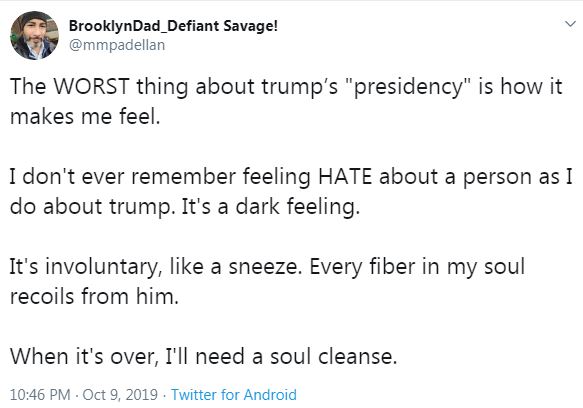
I know a lot of us really enjoy ourselves some hyperbole, and that Twitter discourse does not smoothly align with what happens in real-life. But I quickly developed a sense of having stumbled upon something definitive and decisive about Trump-era liberalism when I saw the following tweet:

Worst Tweet 20191010

It’s difficult to begin to fully describe everything maddening and pathetic about that statement, but since this is a blog post about it, I’m gonna try.

This tweet is like a fully evolved iteration of the feckless “If Hillary Won, We’d Be At Brunch Right Now” signs that have appeared at various marches since 2017.  It’s a sort of culmination of the #Resistance™ that began in earnest following the 2016 presidential election, the groundwork having been laid by prominent liberal political and media figures who essentially anointed themselves leaders of a movement to defy the oncoming storm of a Trump Administration. And while it’s an absolute necessity to generate massive resistance to the grotesque nature of Trump’s agenda, the mainstream liberal face of the movement was lacking in substance and value from the very start. To put it most succinctly, they took Trump’s election personally and never expanded the reaction much beyond this feeling of being inconvenienced and generally upset.

Conservative pundit Ben Shapiro, an intellectual fraud inexplicably respected among the online-right, has long had a fondness for “owning the libs” with the catchphrase “facts don’t care about your feelings.” He and many like him just love to label anyone expressing compassion as a bleeding-heart snowflake, too prone to fits of emotion in the face of the muscle-flexing juggernaut that is Logic. But rather than serving as a general axiom for navigating the difficulties of everyday life, conservatives of Shapiro’s ilk just use “facts don’t care about your feelings” as a double-ended bludgeon: to claim that factual reality necessitates conservative policy and that human emotion is a sign of flaws and weakness. It doesn’t much matter what the topic at hand is, conservatives will shoehorn the facts-versus-feelings dynamic in wherever it suits their ideology. Does a relatively small number of mega-wealthy elites exert too much power and drive catastrophic income inequality? Too bad, they earned their position in the world and you’re a pussy for crying about it. Are you concerned about the US government’s violent, cruel, and careless foreign policy? Tough luck, we’re fighting for freedom and civilian casualties are just the cost of doing business in a world of good versus evil. This exercise could drag on considerably, but the key flaw in this Facts & Logic fetishism is that the right often relies on premises that are far from factual, often open for debate, and sometimes even foundationally bullshit. What this approach typically represents is them claiming the Land of Logic in the name of the right and then reverse-engineering their own preset feelings into what they conveniently consider to be the facts that support them.

None of this is to say that facts have no place in a world that should be dominated by feelings. I go to a weekly support group modeled after Recovery International, a self-help mental health organization founded by neuropsychiatrist Dr. Abraham Low in 1937. Among the many tools and guides in the program is the phrase “feelings are not facts.” At first glance this seems uncomfortably similar to Ben Shapiro’s guiding principle. But rather than functioning as a weaponized statement, “feelings are not facts” is intended to calm and empower people who struggle with a variety of mental and emotional struggles. Just because you feel worthless or hopeless or doomed doesn’t make it true. If you avoid social situations for fear of judgment or humiliation, it would help to know it is by no means a fact that everyone is closely watching you and waiting for an opportunity to criticize you. That odd or uncomfortable physical symptom you may be experiencing, or disturbing mental state does not automatically mean you are dying of some awful disease or losing your mind. This is the uplifting perspective on the facts versus feelings dynamic, the use of rational thought to ease tension instead of attempting to deflect all criticism and reframe it as emotional immaturity.

Maybe this all sounds like a “both sides!” detour from the subject, but almost immediately upon reading this tweet I got a sense of a real snag in this user’s facts and feelings priorities. I don’t dismiss the seething hatred this man feels. I cannot begin to recall all the times I’ve caught myself pacing around angrily in my house, ruminating on some new horror the Trump administration has brought into being. I agree that it’s miserable to feel this way, however naturally it may come. But I’m more interested in what informs such feelings and how they are expressed. What is the primary issue? Is it the dark, helpless negativity you feel? Are you the victim here, BrooklynDad? And “when it’s over” will equilibrium be reestablished by your “soul cleanse?” Is the Trump presidency an aberration bookmarked by eras of happy normalcy?

It may seem petty and nit-picky but this brand of faux-liberal, centrist narcissism consistently seems to ignore the primary victims not only of Trump’s policies but of American policy in general. A lot of us are profoundly upset and disturbed by this administration’s actions, from the separation of immigrant families, the imprisonment of children in literal concentration camps, complete disregard for catastrophic climate change, continued reckless use of military terror abroad, racism, sexism, assault on LGTBQ rights, disgraceful tax policies, and the constant, full-throated, pathetic stream of lies. I think some of those could vie for the honor of “WORST thing” of Trump’s presidency. And they qualify for that distinction not because of how they make me, or anyone else, feel, but because they are de facto morally repugnant and cause grave material harm to broad swaths of people. To varying degrees, his ideology and behaviors are bad purely because they drive death, destruction and decay. And even though Feeling Bad is the natural response to such matters, that bad feeling is a side-effect, a reaction.

Ideally, I believe a person’s values will drive their emotional reactions to the reality (facts) they encounter or experience. And the behaviors driven by those emotional reactions are, in my opinion, most revealing of a person’s values. Are you going to go on social media to post emotional screeds about how the president hurts your feelings, or are you going to center the primary victims of his policies when you discuss him? Are you going to engage the moral roots of destructive policy or are you going to find a way to twist it into a cathartic “YAAAS KWEEN” viral tweet to get Likes and Retweets from legions of wine moms and #StillWithHer drones? To put it in the clearest terms, when you criticize and excoriate the Trump (or any powerful figure), are you centering his victims or are you putting yourself on the cross?

I don’t mean to portray Twitter discourse as the crucial foundation of social struggle. I am fully aware that most of us Online People are little more than keyboard jockeys duking it out with varying levels of elevated self-importance. And while there is no substitute for protests, demonstrations, and other forms of direct action, I do believe that the way we communicate and express ourselves in all forums and mediums does carry some importance. I think it’s a safe assumption that aside from voting, for most of us our primary political engagement (in the US, at least) comes in the form of social media participation and consumption. And while that may not seem significant taken at face value, the ideas communicated and absorbed can have a significant influence when spread among enough minds over time. And as those things evolve and disperse, so do the minds of all of us engaged in it, which can create an atmosphere of more significant and substantial resistance, inspire more direct action, and strengthen the resolve of The People to demand the justice and respect we all deserve. So try not to focus on feeling bad for yourself. Take the next step and let yourself be an ally for those directly targeted and harmed. On large enough scale, it can foster the solidarity we need to counter our oppressors in ways they cannot stave off.

The Center Must Fold

Conventional wisdom has led us astray,
That empty habit of wishing away.
The eyes of the evil are staring us down,
And at their behest the world will drown.
And as we advance toward this fate unknown,
We’re growing to feel forever alone.
But there always remains a decision to make,
And time-honored maxims for us to break.
So allow me to offer an idea so bold,
At this late date the center must fold.

“Surely you jest,” detractors will state,
Obsessed with civility in the face of hate.
“Well that’s too extreme,” the privileged proclaim,
From positions removed from a world aflame.
Some may decry “you’re just divisive!”
Never to offer a thought more incisive.
Say what you must about my attitude,
But know that I offer more than just platitude.
So perhaps reconsider things we are told,
And ponder the notion the center must fold.

A polite reminder for the indifferent and secure,
Your inaction is more than most can endure.
For each of us blessed with lives of stability,
Countless more live in constant fragility.
A strain of ruthlessness pervading society,
Mixed with catastrophes of manmade variety.
As the makers of atrocity endure unresisted,
Consider the multitudes who mindlessly assisted.
So again I suggest we recast of the mold,
Before we advance, the center must fold.

Here we consider our first decision,
We stay the course without further revision.
Desperation accelerates beyond repair,
And billions of souls will succumb in despair.
Seas will boil and land will smolder,
Deaf to the cries of every last shareholder.
Our only lasting, grand distinction:
A finely crafted mass extinction.
Should such visions turn your blood cold,
You’ll then understand the center must fold.
And so we must forge an an alternate path,
A journey to lead us from our own wrath.
An ambitious endeavor not without pain,
But one worth taking to end havoc’s reign.
So no longer shall riches be life’s meaning,
Nor modern subsistence be so demeaning.
Hostility discarded with horror it creates,
Resist the urging of empire’s mandates.
Extend compassion to those under chemical spells,
Rather than casting them in concrete cells.
Scrap all the laws that enrich those in power,
Demand our respect until they all cower.
And still humanity may be imminently finished,
Unless skies and seas are cleansed and replenished.
Should these words inspire and excite you,
Allow me to humbly and eagerly invite you.
For survival is not gained by toiling in seclusion,
But power is increased through concerted transfusion.
And if you consider me a pigheaded scold,
Reality still asserts, “the center must fold.”

Un-American

This is the part where I’m supposed to open with something banal and faux high-minded like “‘being American’ means many different things to many different people” or “one man’s ‘un-American’ is another man’s ‘patriotic’”. I like to think you’re already aware of such things, and that you don’t like being patronized. There’s obviously a rich history of people combatively trying to define and take ownership of what it means to “be American” and who should be branded with the mark of “un-American” or “anti-American.” And while I’m about to engage in this to an extent myself, I really want to make the case for looking beyond this patriotic pissing contest when we discuss our affairs and policies. Why hide behind these appeals to American identity and idealism when we ought to just cut to the chase and say what we’re really talking about? Right versus wrong. Should versus shouldn’t.

I started thinking about this little piece in June of 2018, a moment when national attention focused squarely on the United States’ practice of separating undocumented immigrant children from their parents and placing them in detention facilities as a part of the Trump Administration’s zero-tolerance policy on illegal immigration. There has been extensive bickering over who’s fault it is, the legality of the practice (and whether or not the legality is even relevant), and thanks to Attorney General Jeff Sessions we’ve even had to discuss this policy in context with Christian scripture. But one point of indignation, typically raised by establishment-minded liberals, centrists, and disingenuous anti-Trump republicans is this six-word mantra: “this is not who we are.” This practice of armed agents of the state tearing terrified and crying children from their parents and taken into cages and holding pens, well “this is not who we are,” they declare. This appeal to who “we are” as a nation, is a clear attempt to paint the practice as un-American. And as many people immediately and correctly responded: yes, this is in fact exactly who we are.
Which brings me to the meat of the issue — in many significant ways, American values and rhetoric are frequently at odds with American practice and behavior. Whether based in blindness to the country’s history, shameless partisan hackery, or just plain cognitive dissonance, there always seems to be an excuse for our society’s conduct, past and present. The examples are almost too numerous to list, too tedious to analyze for the purpose of this piece, but the broad strokes must be mentioned. The very establishment of our country was based in conquest and genocide of the native people, with the subsequent building and development coming via the brutal exploitation of African slaves. And as time slowly crept forward, our domestic policy begrudgingly extended citizenship and quasi-freedom to black people, voting rights to women, a few scraps of semi-autonomous land to the remaining natives, and marriage rights to homosexuals. Valid gains to be sure, but all at significant human costs and with inherent conditions that ultimately limit their value. The civil rights horror-show always dragged along slowly and painfully, and still does to a considerable degree. And then there’s the exploitation and utterly heartless treatment of American workers. Again, another arrow that has bent toward progress but one that is perhaps the most behind schedule and even regressing at this moment in time.
On the topic of foreign policy, for the last few centuries our freedom and democracy-loving government has functioned as a merciless and bloodthirsty juggernaut, marching around the planet to expand our sphere of influence, ensuring “American interests” are present at nearly any given time or place, interests that can subsequently be declared “at risk” any time some other society makes the grave and audacious calculation to pursue any form of self-determination that doesn’t have the full blessing of America’s shadowy corporate elite. In that case, our options have been either direct military intervention or various backdoor machinations to install and support any ruthless and bloodthirsty dictator we can find to do our bidding. Of all the ugly legacies threaded into the fabric of American history, this could be considered the most consistent and prominent. Our role in World War II could have been a mostly honorable exception, but the detonation of two nuclear bombs, the annihilation of Dresden, and our own internment of Japanese-Americans cast a dark and heinous shadow on the endeavor.
Why the focus on the negatives? To be sure, the United States has been witness to great advances in humanity and civilization. Many great and brilliant Americans have innumerable accomplishments to their names. But none of this good erases the bad. None of it excuses the persistent shame coursing through our nation’s existence. And that brings me back to the point — the American Exceptionalism we often proclaim is almost constantly a direct contradiction of the actions we take. And it’s significant because it continues in full force to this day.
To a degree, I understand that many people have an urge to form and emulate national identities and ideals. Maybe people like to believe that not only are they good and decent individuals, but also that the societal values they inherit are fundamentally right. It’s much more easy and comfortable to accept and work within the ideological framework one is given than it is to examine it with a critical eye and forge a new path. And the longer people allow pride to become associated with this inherited identity, the harder it is to change. So when ultimately challenged, those that are bound to their sense of American ideals will either go into spectacular mental gymnastics to marry our ugly historical behavior to our flowery stated ideals, or they’ll just ignore history altogether: “this is not who we are!” (A third response is simply unabashed white nationalism).
These things could be discussed and dissected at great length for other purposes but my point here is that couching political discourse in American versus non-American terms accomplishes nothing worthwhile. Any behavior or value is good or bad on its own merits, completely unrelated to the human-made geographical boundaries it inhabits. If, for example, someone advocates for single-payer healthcare and is derided as un-American, what the fuck does that even really mean? Or conversely, if a group of protestors is lauded as “truly American” for their dissent, what should one infer from such a ludicrous statement? Is universal healthcare bad because some people think it’s un-American? Is freedom of expression somehow special only because it an oft-stated American value? It’s ridiculous to make moral judgments on these things based on their perceived fit within a country’s history. It’s merely a tactic used to avoid substantive discussion, an irrelevant, meta-statement empty of value. Such behavior only derails the discussion into pointless and ugly divisiveness that ultimately perpetuates the destructive nationalist ethos that has slithered its way throughout the ugliest branches of American history.
There is probably some truth to the argument that a society, whether bound by regional factors or defined by literal statehood, will create and maintain an evolving identity with some norms unique to itself. I suppose it’s an inescapable aspect of life. But no society should allow its ability to navigate domestic affairs and conflicts to be inhibited by counterproductive appeals to its own self-image. It’s empty and pathetic behavior, and Americans would be doing themselves a great favor by removing this barrier from The Discourse.